
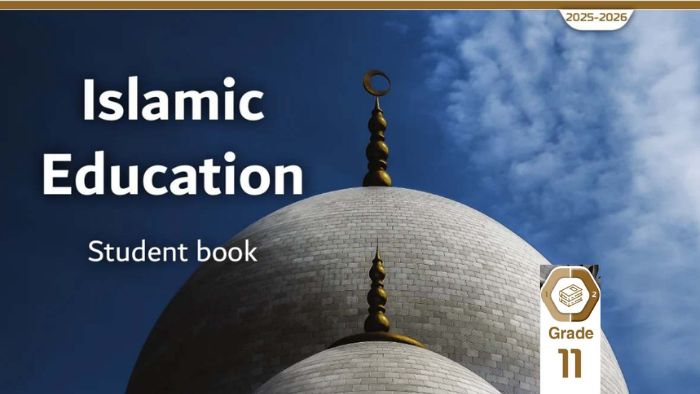
كتاب الطالب اسلامية منهج انجليزي للصف الحادي عشر الفصل الثاني، تجدون رابط تحميله تحميل مباشر بصيغة PDF تحميل مباشر، على موقع امارات سكول. وفق منهاج وزارة التربية و التعليم في الإمارات العربية المتحدة الموسم الدراسي 2025-2026.
كتاب الطالب اسلامية منهج انجليزي الصف الحادي عشر الفصل الثاني 2026
كتاب الطالب اسلامية منهج انجليزي للصف الحادي عشر الفصل الثاني وفق المنهاج الاماراتي وكذلك كتب الصف الحادي عشر تجدوها على موقعنا للتحميل على شكل ملف PDF.
مقدمة كتاب الطالب اسلامية منهج انجليزي للصف الحادي عشر الفصل الثاني:
“Praise be to Allah, Who taught illiterate man (by the pen), taught man that which he knew not (writing) and praise be to Allah the Lord of the worlds and may the blessings and peace of Allah be upon the most honored of messengers our master Muhammad (2) and upon all his family and Companions”.
This is the text book on Islamic Education, which we present to our dear sons and daughters the students eleventh grade, hoping that it proves to be beneficial to them.
In terms of structure, this book has adopted a unit-based approach. Each unit addresses diverse topics that collectively represent the domains and focal points of the curriculum discussing Divine Revelation, creed, the values and morals of Islam, the rulings of Islam and their purposes, the biography of Prophet Muhammad, prominent Muslim characters, national identity and contemporary issues.
The authors of the book were keen on translating curriculum criteria into comprehensive content; this necessitated identifying the outcome of learning criteria at the beginning of each lesson under the heading ‘This lesson teaches me’.
Each Lesson comprises an introduction titled “I take the initiative to learn”. and a presentation under the heading “I use my skills to learn” and a conclusion under the heading “I organize my concepts”. This is followed by student activity.
which has focused on three types: a general activity to all students. This is titled “I answer by myself”. There are enriching activities for distinguished students titled “Enriching my experience” and applied activities titled “I assess myself”.
The book embeds an attempt to strike a balance between religious knowledge and learning activities by introducing the necessary religious knowledge and concepts to students. It has also provided them with a simultaneous gateway to increase and enrich their knowledge via classroom learning activities. The book has also targeted the realization of the characteristics of Emirati students in this age-group and developing those characteristics that peculiarly belong to the 21st century, thinking skills and the requirements of sustainable development.
The book has focused on religious knowledge and concepts that are required by students in this age-group and on linking this knowledge and these concepts to contemporary life and its novelties in the light of the principles of Sharia, whose hallmark is moderation, tolerance, positivity and individual and communal responsibilities. The book has also accorded attention to developing performance skills that relate to Islamic education and has given special emphasis to Islamic values in pursuit of structuring conscious personalities that adhere to religion and contribute to nation building.
Moreover, the book comprises multiple and diverse learning activities that contribute to developing critical thinking in students. This is a contemporaneous requirement that fortifies students against deviant ideas and uninformed imitation.
Critical thinking also contributes to developing creative and inventive thinking: as part of UAE’s Centennial Plan 2071 of achieving excellence and innovation in Education. In its scheme, the book also seeks to develop skills of problem solving and making sound decisions in a timely manner and contributes to sharpening the skills of students and raising their awareness by investing in material and human potentialities and preserving and developing the nation’s wealth.
We hope that the method of presenting topics to students aids them in utilizing their innate faculties of learning- observing, thinking, experimenting, applying, self-learning, researching, investigating and deriving conclusions built on evidence and proof.
We present this book to our sons and daughters the students hoping that it realizes the benefits perceived at the time of compiling it. These benefits comprise realizing the criteria of learning Islamic Education and developing thinking and performance skills in a persistent endeavor to equip this generation of students with the tools necessary for ingenuity, inventiveness, meeting challenges and achieving supremacy for the homeland.
Allah knows best the intention behind our deeds.
Authors of Islamic Education Curriculum